
How to Choose an Interior Designer in San Diego: 7 Questions to Ask Before You Hire
Hiring a residential interior designer is one of the most important decisions you will make for your home. The right partner protects your investment, your timeline, and your day-to-day life. The wrong one creates stress, delays, and a finished space that never quite fits how you live.
In a market like San Diego, the stakes are even higher. Coastal homes, hillside builds, historic remodels, and modern new construction all come with their own challenges. Climate, light, lot conditions, and lifestyle expectations vary widely from neighborhood to neighborhood. A designer who understands those nuances will guide you to better outcomes. A designer who does not will cost you time and money.
At Moniker Design Studio, residential design is one of our core practices. We work with homeowners across San Diego County to create homes that feel personal, considered, and built to last. Before you sign on with any firm, here are the seven questions we recommend asking. They will help you separate marketing language from actual capability and find a designer who fits how you live.
1. What Does Your Design Process Actually Look Like?
This is the most revealing question you can ask. Every designer will say they have a process. Few can walk you through it clearly.
A strong process gives you visibility into what happens at each stage. Discovery, concept, design development, sourcing, procurement, and installation should each have defined inputs and outputs. You should know what decisions you will make, when you will make them, and how those decisions move the project forward.
When we walk clients through our process, the goal is clarity. Each phase has a purpose. Each handoff is intentional. That structure protects your timeline and your budget. It also reduces the most common source of frustration in residential projects, which is uncertainty about what comes next.
If a designer cannot explain how they work in concrete terms, the project will likely reflect that same lack of structure once it starts.
Designing for Dwell Time Across Restaurants, Cafés, and Hotel Lobbies
In Southern California, indoor and outdoor living blur. Guests expect spaces to flex with the day. That makes dwell time one of the most important drivers of revenue. The longer a guest chooses to stay, the more opportunities the space has to generate revenue.
Comfortable seating, natural light, and intentional spacing encourage guests to settle in. In a restaurant, that means an additional course or round of drinks. In a hotel, it means:
Guests purchasing food and beverage from the lobby café or bar
Increased usage of on-site amenities throughout the day
A stronger perception of the property's overall value
In a smaller footprint, the same logic applies. For Copa Vida, a coffee shop in San Diego's Sorrento Valley, we handled the furniture design. That is the layer guests are in most direct contact with throughout a visit. In a café, that work shapes whether someone grabs a coffee and goes or settles in to stay. That is the difference between a single transaction and an extended one.
The Oaks Resort, set in the hills outside San Diego, shows this principle at scale. We did not design purely for overnight stays. We built the interiors to support leadership conferences, company retreats, and extended on-site engagement. Residential-style rooms, a coffee-shop-inspired communal dining space, and custom millwork and furnishings by our sister fabrication company Moniker Building Co. create an environment where guests naturally gather, linger, and interact.
The result is a property that blends rustic surroundings with a more elevated, modern experience. Materials are layered to bridge the two. Neutral foundations, custom furnishings, and warm textures feel familiar but considered. Guests experience comfort and a sense of intention from the rooms through the shared spaces. Usage increases across the property, from dining to gathering areas. The resort becomes a destination rather than just accommodation.
Layouts That Support Flow in High-Traffic Hospitality Environments
If dwell time determines how long guests stay, flow determines how many can move through a space without friction. In a Southern California market that swings between locals on weekday mornings and tourists at peak-season weekends, that capacity matters.
A restaurant needs to move guests efficiently from entry to ordering to seating. A hotel lobby has to handle check-in traffic, luggage movement, seating, and often food and beverage service all at once. Strategic zoning makes this possible. Clear pathways guide guests from one moment to the next without confusion. The result is a space that handles volume while still feeling curated and calm.
From a revenue perspective, this matters because:
Faster, smoother ordering increases throughput during peak hours
Reduced friction leads to higher conversion at the counter
Multiple zones create additional opportunities for spending
A well-designed layout lets a business serve more customers in the same footprint. That is one of the most direct ways to increase revenue.
2. Have You Worked on Homes Like Mine in San Diego?
Experience matters, but relevant experience matters more. A designer who has spent years on commercial projects may not be the right fit for a coastal remodel. A designer who only works in new construction may struggle with the realities of an older home in Mission Hills or South Park.
Ask to see projects with similar scope, scale, and style. Pay attention to how the designer talks about the constraints they navigated. The best portfolios are not just collections of pretty rooms. They are records of problems solved.
Our work on our Encinitas Kitchen remodel project is a good example. The space needed to feel open and connected to the rest of the home while still functioning as a hardworking family kitchen. Material choices had to hold up to coastal humidity. The layout had to support how the family actually cooks and gathers. None of those decisions were aesthetic alone. They were responses to how the home is used and where it sits.
Look for that same depth of thinking in the work you review.
3. How Do You Approach Budget and Pricing?
Budget conversations are uncomfortable for many homeowners. A good designer makes them straightforward.
You should expect transparency in three areas:
How design fees are structured, whether flat fee, hourly, percentage-based, or hybridHow product, furniture, and material costs are presented and marked upHow change orders and scope adjustments are handled during the project
The goal is not the lowest number. The goal is alignment. A designer who understands your budget from the start can make decisions that serve it throughout the project. A designer who avoids the conversation will deliver surprises later.
We recommend asking for a realistic range based on the scope you are describing. If a designer cannot give you one, they either do not have the experience to estimate it or are uncomfortable being direct. Neither is a good sign.
4. Who Will Actually Be Working on My Project?
In many studios, the person who sells the project is not the person who runs it. That is not necessarily a problem, but you should know up front who will be involved and in what capacity.
Ask who your primary point of contact will be. Ask who handles sourcing, who manages the trades, who is on site during install. Ask how often you will hear from the team and through what channels.
Residential design is personal. The relationships built during a project shape the experience as much as the design itself. You want to know the people you will actually be working with, not just the firm's principal.
2. Have You Worked on Homes Like Mine in San Diego?
Experience matters, but relevant experience matters more. A designer who has spent years on commercial projects may not be the right fit for a coastal remodel. A designer who only works in new construction may struggle with the realities of an older home in Mission Hills or South Park.
Ask to see projects with similar scope, scale, and style. Pay attention to how the designer talks about the constraints they navigated. The best portfolios are not just collections of pretty rooms. They are records of problems solved.
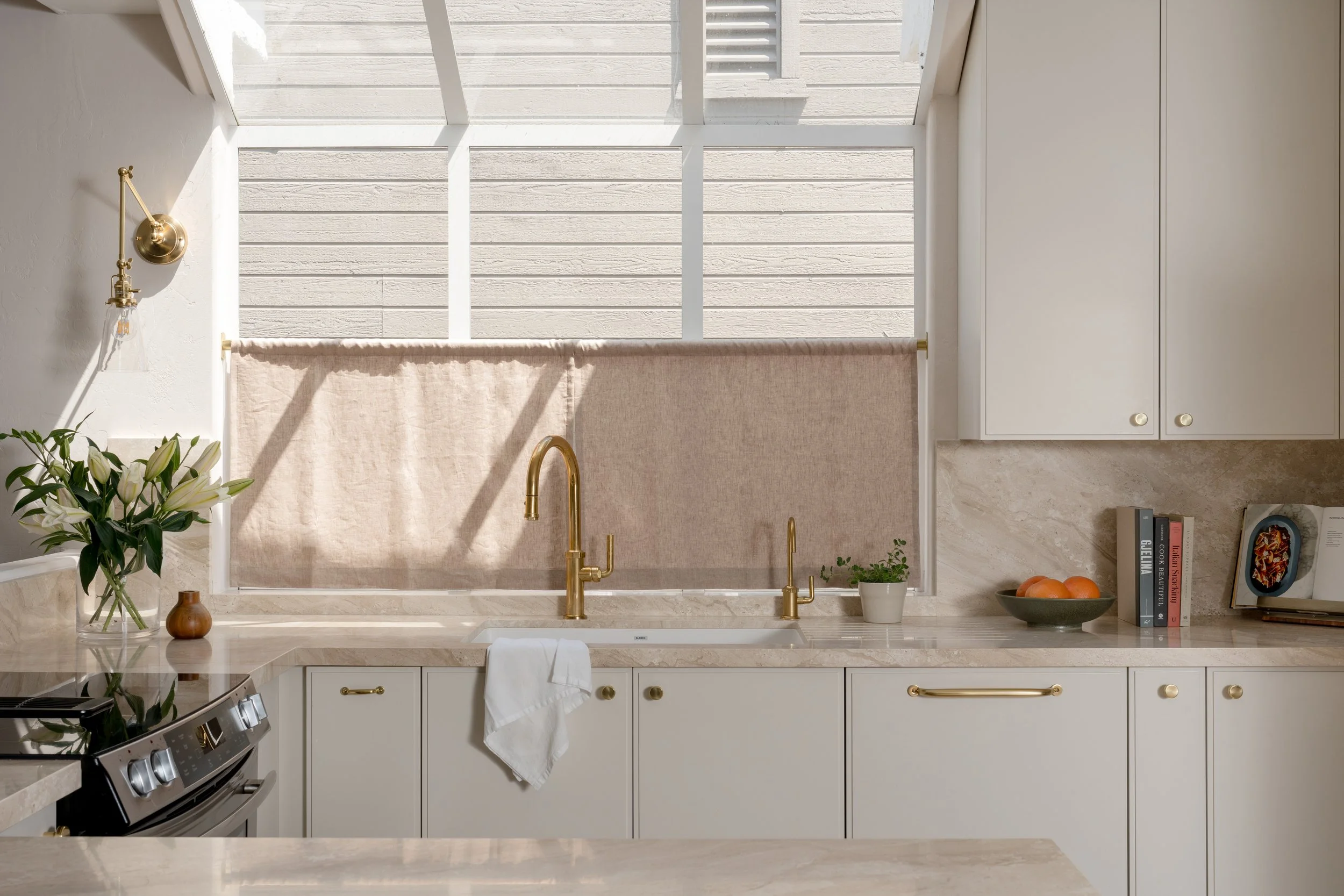
Our work on our Encinitas Kitchen remodel project is a good example. The space needed to feel open and connected to the rest of the home while still functioning as a hardworking family kitchen. Material choices had to hold up to coastal humidity. The layout had to support how the family actually cooks and gathers. None of those decisions were aesthetic alone. They were responses to how the home is used and where it sits.
Look for that same depth of thinking in the work you review.
3. How Do You Approach Budget and Pricing?
Budget conversations are uncomfortable for many homeowners. A good designer makes them straightforward.
You should expect transparency in three areas:
How design fees are structured, whether flat fee, hourly, percentage-based, or hybrid
How product, furniture, and material costs are presented and marked up
How change orders and scope adjustments are handled during the project
The goal is not the lowest number. The goal is alignment. A designer who understands your budget from the start can make decisions that serve it throughout the project. A designer who avoids the conversation will deliver surprises later.
We recommend asking for a realistic range based on the scope you are describing. If the interior designer cannot give you one, they either do not have the experience to estimate it or are uncomfortable being direct. Neither is a good sign.
4. Who Will Actually Be Working on My Project?
In many studios, the person who sells the project is not the person who runs it. That is not necessarily a problem, but you should know up front who will be involved and in what capacity.
Ask who your primary point of contact will be. Ask who handles sourcing, who manages the trades, who is on site during install. Ask how often you will hear from the team and through what channels.
Residential design is personal. The relationships built during a project shape the experience as much as the design itself. You want to know the people you will actually be working with, not just the firm's principal.
5. How Do You Balance My Style With Your Design Point of View?
This question separates designers who execute a single signature look from designers who tailor their work to each client.
Both approaches are valid, but they produce very different outcomes. A signature-style designer will deliver a home that fits their portfolio. A client-driven designer will deliver a home that fits you. Most homeowners want the second, but assume they will get it automatically. They will not.
Our approach is rooted in what we call people-first residential interior design. The home is for the people who live in it. Our role is to translate how you live, what you value, and how you want to feel in your space into a design that holds up over time. That requires listening before designing.
Ask the interior designer to describe a project where they pushed back on their own instincts to serve the client. The answer will tell you a lot about how they work.
6. How Do You Handle the Construction and Install Phase?
Design on paper and design in the field are two different things. The best concept means little if the install is rushed, the trades are mismanaged, or the final details are not held to the same standard as the renderings.
Ask how the designer coordinates with general contractors, fabricators, and installers. Ask how they handle unexpected site conditions. Ask what their role looks like during the final weeks of a project.
Our Carlsbad based whole home project is one example of how that coordination plays out. The home required careful integration between architecture, custom furnishings, and finish work. Each element had to land precisely for the space to feel cohesive. That kind of outcome only happens when the designer stays involved through install rather than handing off after specifications are finalized.
Am interior designer who treats install as someone else's responsibility is leaving the most important phase of the project to chance.
7. What Happens After the Project Is Complete?
The end of a project is not the end of the relationship. Furniture arrives late. A finish needs touch-up. A piece of millwork settles and needs adjustment. Real homes have real wear, and the first year after install often surfaces details that need attention.
A good designer plans for that. Ask how they handle punch lists, warranties on custom pieces, and post-install support. Ask whether they offer styling refreshes or future-phase planning once you have lived in the space for a while.
The best residential relationships extend across years and often across multiple homes. Designers who think that way show it in how they close out a project. They do not disappear after install.
The Bottom Line: Hire for Fit, Not Just for Portfolio
Choosing an interior designer in San Diego is not about finding the most impressive Instagram feed. It is about finding the right partner for the home you want and the life you live in it.
The seven questions above are designed to surface what actually matters:
A clear, repeatable process
Relevant experience in homes like yours
Transparency around budget and pricing
A team you trust and can communicate with
A design approach that centers you, not the firm
Strong execution through construction and install
A relationship that extends beyond the final reveal
If you are considering a residential project in San Diego, reach out to our team to start the conversation. We are happy to walk you through our process, share relevant work, and help you decide whether we are the right fit for what you are building.
FAQs: Hiring an Interior Designer in San Diego
How much does it cost to hire an interior designer in San Diego? Costs vary widely based on scope, square footage, and the level of customization involved. Most residential projects in San Diego range from focused single-room work to full-home design. A reputable designer will give you a realistic range early in the conversation based on your goals.
What is the difference between an interior designer and an interior decorator? Interior designers work across the full scope of a space, including layout, materials, finishes, lighting, and often custom millwork and furnishings. Decorators focus primarily on furniture, styling, and surface-level aesthetics. For renovation or new construction projects, you typically want a designer.
How long does a residential interior design project take? Timelines depend on scope. A single room may take a few months from concept to install. A full home or major remodel often runs nine to eighteen months, depending on construction timelines, lead times on custom pieces, and the complexity of the work. Sometimes, very large or comprehensive projects can be in design for a year or more before construction starts.
Do I need an interior designer if I am already working with an architect or builder? Yes, in most cases. Architects shape the structure of a home. Builders construct it. Interior designers shape how you live inside it, including layout refinement, material selection, finishes, lighting, and furnishings. The three roles work best in coordination.
When is the right time to bring an interior designer into a project? As early as possible. Bringing an interior designer in during the architectural or pre-construction phase allows for better integration of materials, layout, and custom elements. Waiting until construction is underway often limits the design options available to you.
